
Ready to Try GoHighLevel?
Get the all-in-one platform for CRM, automations, funnels & websites — built for agencies.
Start your free trial and explore every feature.
Keap has been running businesses for two decades. That is exactly why a Keap to HighLevel move feels risky. There are years of contacts, tags, campaigns and orders sitting in there, and nobody wants to be the person who loses them.
Here is the calming truth. Data loss is rarely what goes wrong in a Keap to HighLevel migration. The real risk is quieter. Campaigns that were never rebuilt, so nobody gets followed up for three weeks and nobody notices.
This guide walks the whole move using the official documented behaviour of both platforms, so you know what is fact and what is opinion.
What moves and what does not in a Keap to HighLevel migration
Moves as data. According to the official Keap export documentation, you can export contact lists, referral partners, opportunities, orders and various reports.
Does not move. Campaigns, campaign sequences, email templates, landing pages, order forms and internal forms. None of these come out in a format another platform can read. Every one of them is a rebuild inside HighLevel.
That second list is where the work sits. The export is an afternoon. The rebuild is the project. Budget your time that way and nothing goes wrong.
Why businesses start a Keap to HighLevel migration
Three reasons show up most often.
Cost as you grow. Keap pricing climbs with contacts and seats. HighLevel charges per account rather than per contact. The official HighLevel pricing page lists Starter at $97 a month, Unlimited at $297 a month and Agency Pro at $497 a month, with a 14 day free trial.
Everything in one login. Texting, booking, funnels, websites and review requests are built in, so several other subscriptions can be switched off.
Agency work. Agencies want one system they can copy to every client under their own brand, which sub accounts and snapshots make simple.
Your reason shapes the rebuild. If cost is the driver, rebuild only what you use and keep it lean.
Prepare before any Keap to HighLevel migration
Four things, one hour, and the rest of the project gets easy.
1. Decide your cutoff. Most Keap accounts carry years of dead records. Contacts who never replied, opportunities lost in 2021, duplicates from an old form. Moving rubbish costs nothing in fees and everything in clarity.
2. List your custom fields. Every custom field you actually use needs a matching field created in HighLevel before you import.
3. Screenshot your campaigns. Open every campaign you rely on and capture the trigger, the wait times, the decision points and the message wording. This is your rebuild plan.
4. Map your tags. Keap accounts collect hundreds of tags. Decide which ones become HighLevel tags, which become pipeline stages, and which get retired. Doing this on paper first is far faster than doing it inside the software.
Step 1: Export your data for the Keap to HighLevel migration
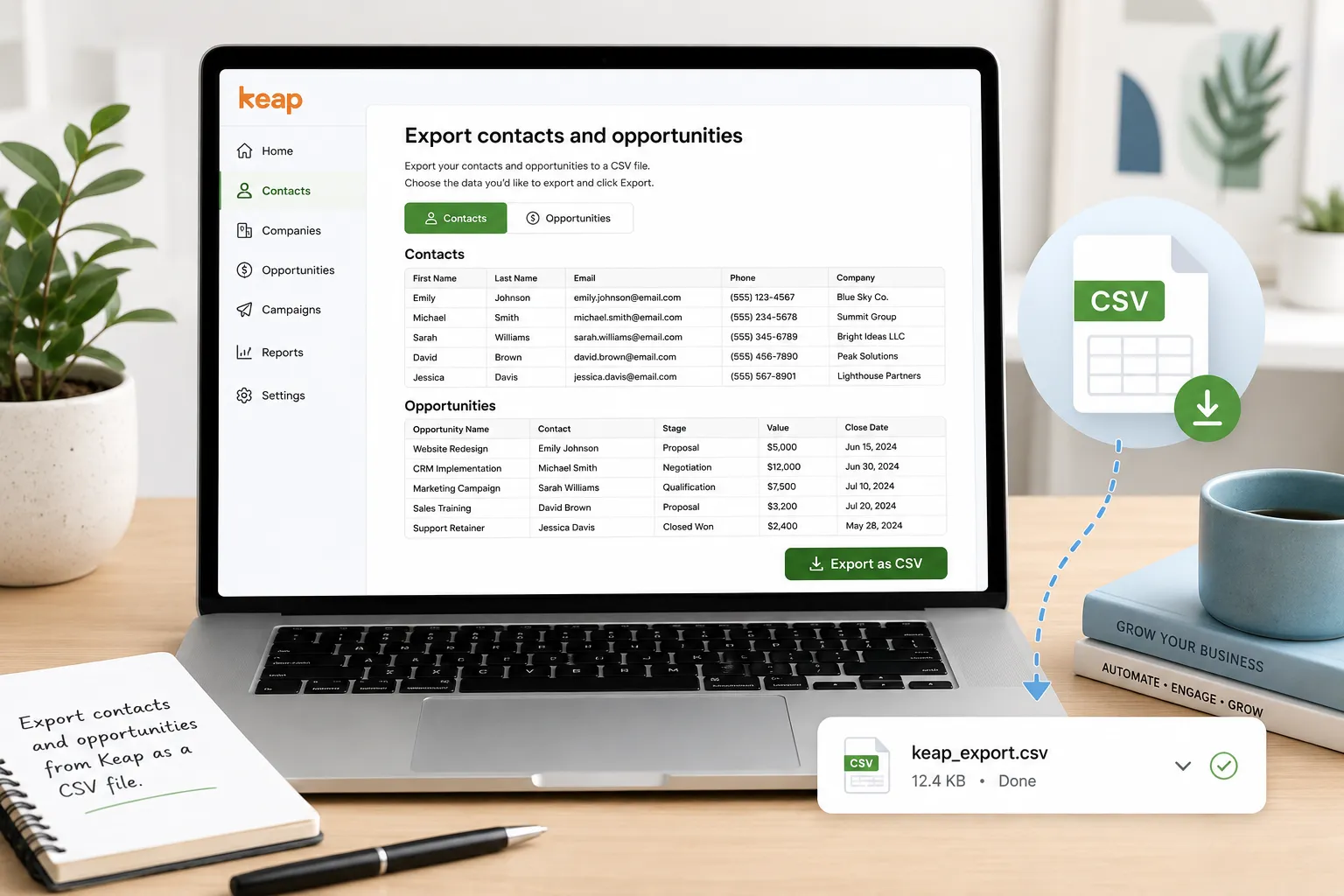
A Keap to HighLevel migration starts with one export per record type. Contacts first, then opportunities, then orders.
The official Keap documentation is clear about the limits, and they matter for planning.
- Formats offered are CSV, Excel or ZIP. Choose CSV, because that is what HighLevel imports
- Up to 1,000 records can be downloaded in the browser or sent as an email link
- Over 1,000 records must be sent through an email link
- Download links expire after 24 hours, so grab the file the same day
- Anyone receiving the email link needs Keap login access to open it
- Include the ID field if you plan to update records later
That 24 hour expiry catches people who start an export on a Friday afternoon. Start it when you can finish it.
Step 2: Clean the file before your Keap to HighLevel migration
This step decides whether your new CRM is calm or messy.
- Delete rows with no name, no email and no phone number, because HighLevel needs at least one of the three to create a contact
- Strip brackets, spaces and letters out of phone numbers
- Make country codes consistent across the whole file
- Remove duplicate rows inside the file itself
- Rename headers to plain words that match your HighLevel fields
- Split anything over 30 MB, which is the import size limit
Save it as a CSV with a single sheet, and make sure the first row is your header row and is not blank.
Step 3: Build your custom fields first
Create every custom field in HighLevel before you import anything.
If a field does not exist, that column is ignored and the data is gone from the import. Fixing it means a second import, and a second import creates duplicates. This is the single most common cause of a messy first week.
Step 4: Import into HighLevel
The official HighLevel import guide says only an administrator can run an import, so check your access before you start.
Open Contacts, choose Import Contacts, then pick contacts only or contacts with opportunities. Upload your CSV, choose create or update, and map every column to the matching field.
Two settings matter. Duplicates are matched in a fixed order: Contact ID first, then email, then phone. And when updating existing records, switch on the option that stops empty values overwriting good data, or a blank cell can wipe a field that already had something useful in it.
Step 5: Rebuild what a Keap to HighLevel migration cannot carry
Open your screenshots and rebuild in this order.
Pipelines first. Recreate your opportunity stages so imported records have somewhere sensible to land.
Forms and calendars second. These are how new leads enter, so they must work before anything else.
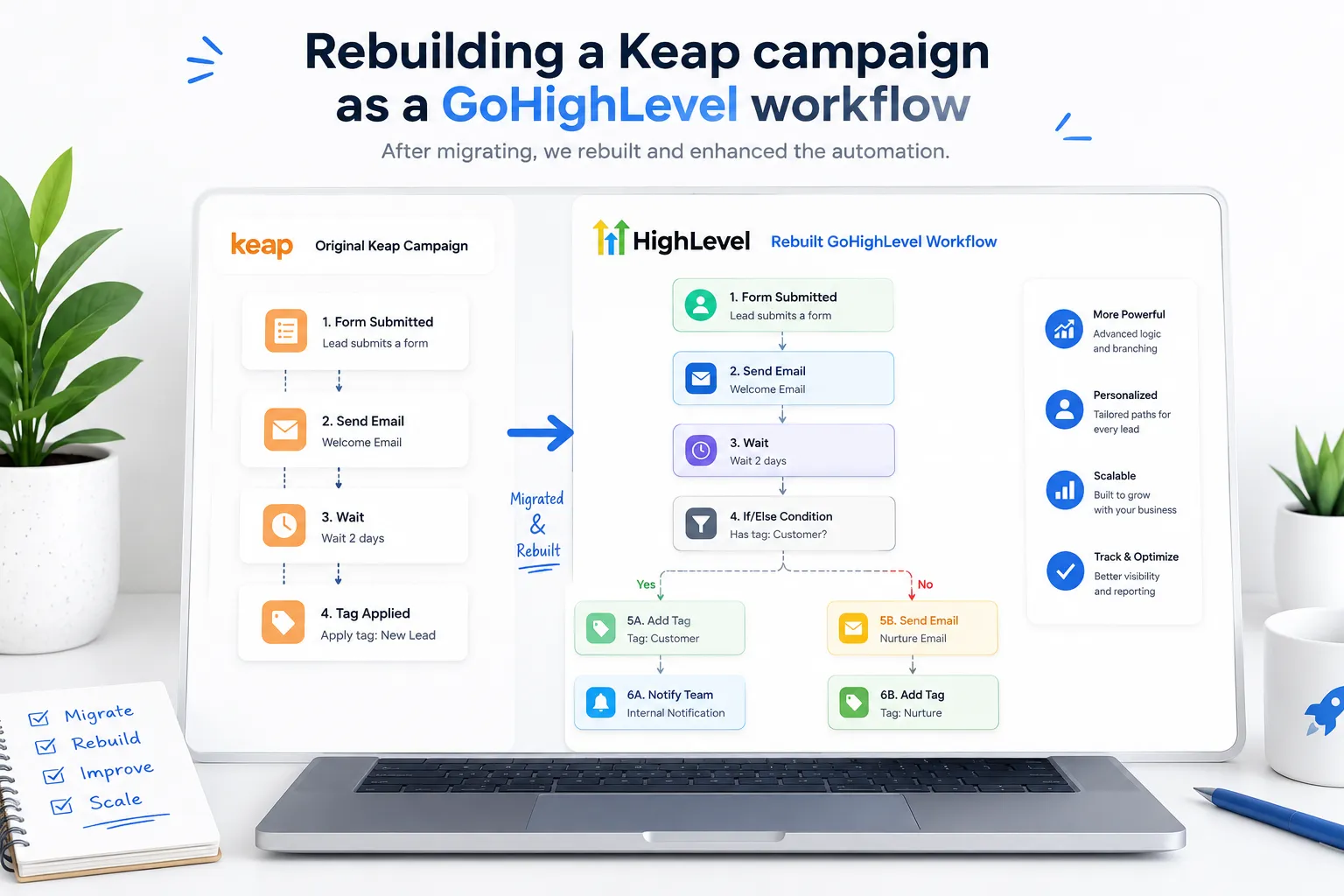
Workflows third. Start with new lead follow up. In every Keap to HighLevel migration we have seen, that single automation carries most of the value.
Templates last. Move your email and text wording across and rewrite anything that mentioned a Keap feature that does not exist here.
Be selective. Most teams find that a third of their old campaigns had been switched off for years.
 This is a good moment to leave them behind.
Tags are the hidden work
Every long running Keap account ends up with a tag for everything. Webinar attended. Webinar not attended. Called and no answer. Bought in 2019. Some accounts carry more than five hundred.
Dragging all of them into HighLevel is a mistake. Tags are cheap to create and expensive to maintain, and a tag nobody reads is just noise inside your CRM.
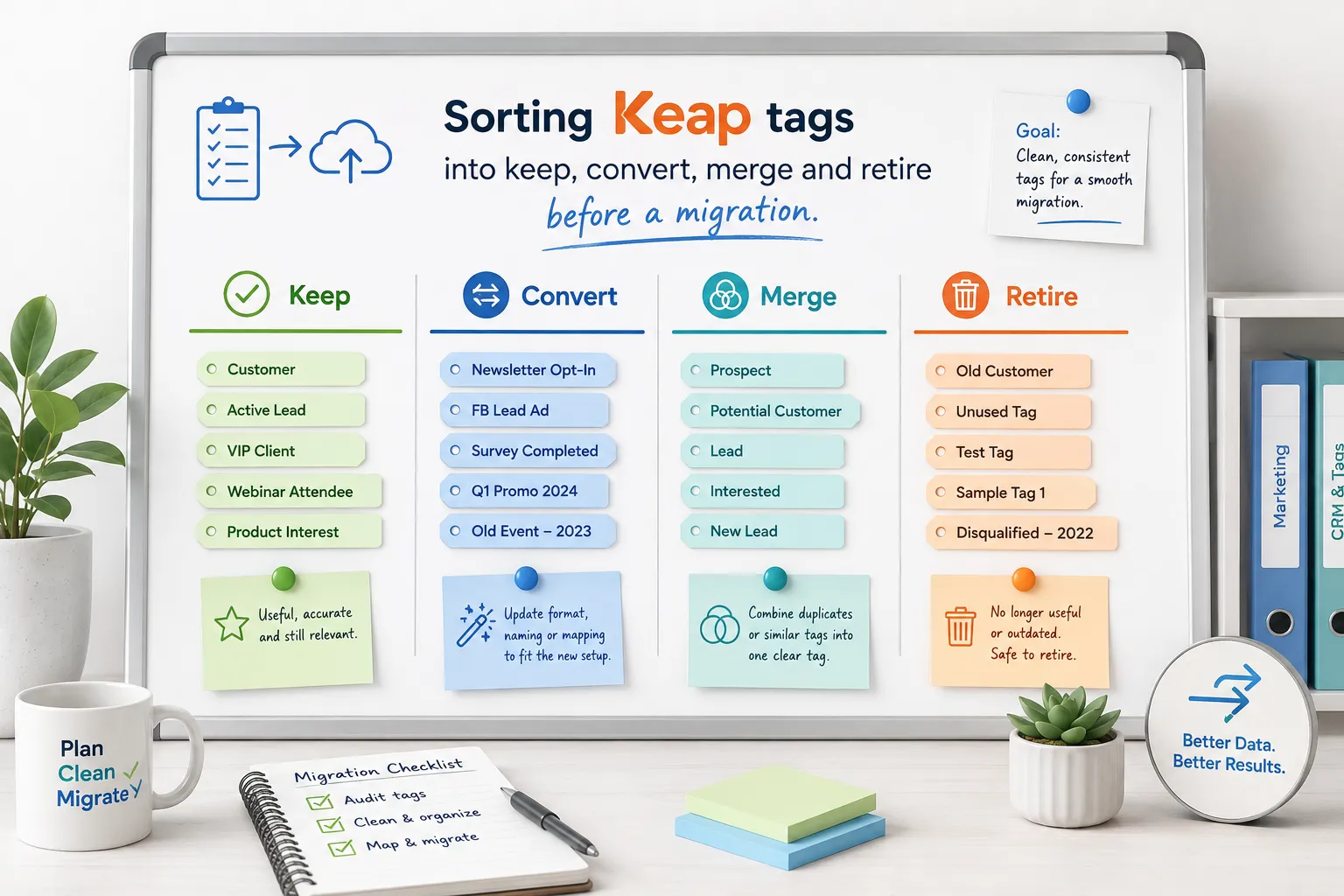
Sort them into four buckets before you move. Keep, because a workflow depends on it. Convert, because it really describes a stage and belongs in a pipeline. Merge, because three tags say the same thing in different words. Retire, because nothing has used it in two years.
Most businesses come out of that exercise with under fifty tags, and the new system is far easier to work in. This is one of the quiet wins in a Keap to HighLevel migration that nobody mentions until they have done it.
Step 6: Do not cancel Keap yet
The safest Keap to HighLevel migration runs both systems side by side for at least two weeks.
Send a real lead through your new forms and follow it all the way to a booked appointment. Check that emails arrive in inboxes and not spam. Confirm your A2P 10DLC registration is approved before you rely on text messages, because carriers block unregistered traffic.
Compare contact counts on both sides. If HighLevel is short, find out why before you cancel anything. Then take one final export from Keap and store it somewhere safe, because once that subscription ends the data is not coming back.
How long a Keap to HighLevel migration takes
A small business with a few thousand contacts and five campaigns takes about one to two weeks.
A long running Keap account with tens of thousands of records, order history and heavy campaign logic takes four to six weeks.
The exporting and importing is rarely more than a day of that. The rest is the rebuild and the testing, and the testing is the part that protects your revenue.
What a Keap to HighLevel migration really costs
A Keap to HighLevel migration has three costs, and most people count only the first.
The platform fee is the obvious one. The rebuild hours are the real one, whether you pay someone or do it in house. And the quiet one is a slightly slower fortnight while your team learns new screens.
Now the other side. Most businesses switch off two or three other subscriptions once HighLevel is live. Count those cancellations before you decide the move is expensive.
Keap to HighLevel migration mistakes that cause real damage
- Importing before the custom fields exist, so values silently disappear
- Letting blank cells overwrite good data during an update import
- Cancelling Keap before a live lead has travelled through the new system
- Importing the same file twice to fix an error, which creates duplicates
- Rebuilding every old campaign instead of only the ones that still run
- Switching on text automation before A2P approval
Every one of these is common and every one is avoidable with a checklist.
When to bring in help
Run the Keap to HighLevel migration yourself if your data is tidy and you rely on fewer than about ten campaigns.
Bring in help when you have order history, complex campaign logic, tens of thousands of records, or a team that cannot afford a broken week. You can see how we scope that work on our GHL migration services page.
Your next step
Open Keap and do the boring part first. List your custom fields, screenshot your live campaigns and decide your cutoff date. That single hour turns a Keap to HighLevel migration into a checklist instead of a gamble.
Then export, clean, build your fields and import in that order. If you are weighing up other platforms too, our HubSpot to GoHighLevel migration guide follows the same process, and our GoHighLevel migration services guide explains what a done for you move should include.
Ready to Get Your GoHighLevel System Built?
We'll build your entire GHL setup for $499 and give you a free professional website.
Contact Us Now
Pingback: ActiveCampaign to GoHighLevel Migration: The Best Complete Guide 2026
Pingback: Mailchimp to GoHighLevel Migration: The Best Step By Step Guide 2026
Pingback: GoHighLevel Migration Checklist: top 6 Phases You Can't Skip