Ready to Try GoHighLevel?
Get the all-in-one platform for CRM, automations, funnels & websites — built for agencies.
Start your free trial and explore every feature.
GHL stands for GoHighLevel (officially HighLevel Inc.). It’s an AI-powered business operating system used by over 1 million agencies and businesses worldwide. It combines CRM, funnels, websites, email, SMS, calls, booking, reputation management, and AI tools (Voice AI, Conversation AI, AI Studio) into a single platform. Pricing starts at $97/month. The platform replaces 8 to 12 separate tools that most agencies and service businesses pay for individually. This guide explains what GHL actually does, why it matters in 2026, and the new AI features that changed how people use it.
You searched “what is GHL” because someone in an agency Slack told you to try it, a competitor is using it, or you saw the term in a YouTube video and want to know what it actually means.
Here’s the direct answer.
GHL is short for GoHighLevel. The official company name is autogencrm.com. It’s a software platform that combines everything an agency or service business needs to run their marketing, sales, and customer communication in one place: CRM, funnels, websites, email, SMS, calls, booking calendars, reviews, automation, and AI tools.
In 2026, HighLevel positions itself as an “AI-powered business operating system,” not just a CRM or funnel builder. That framing is closer to accurate now than it was a year ago, because the AI features (Voice AI, Conversation AI, AI Studio) genuinely changed how the platform works.
This guide breaks down what GHL does, why people use it, the latest AI updates, and whether it’s the right tool for your business.
What Does GHL Stand For?
GHL stands for GoHighLevel. The platform’s official company name is HighLevel Inc. founded in 2018 in Dallas, Texas by Shaun Clark, Varun Vairavan, and Robin Alex.
You’ll see the platform referred to by several names depending on the source:
- GHL (most common in agency communities)
- GoHighLevel (from the domain gohighlevel.com)
- HighLevel (the official company name)
- Go High Level (less common spelling)
- HL (occasional shorthand)
All of these refer to the same product.
What GHL Actually Does
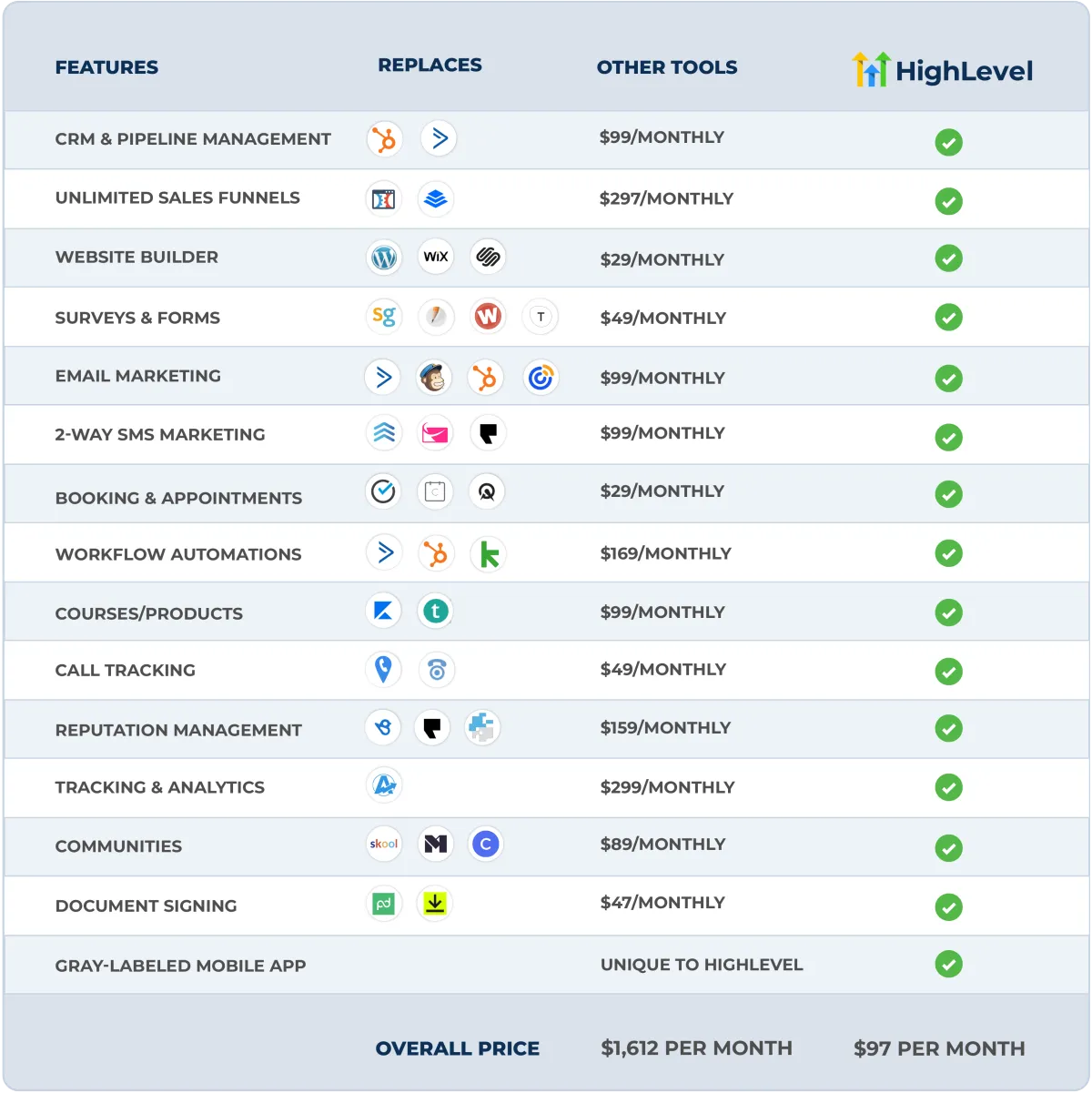
GHL is a single platform that runs an entire marketing and sales operation. Instead of paying for 8 to 12 separate tools and gluing them together with Zapier, you do everything inside GHL.
| What You Pay For Now | What GHL Replaces It With | Typical Monthly Cost |
|---|---|---|
| HubSpot, Salesforce, or Zoho CRM | GHL CRM and Pipelines | $45 to $800 |
| ClickFunnels or Unbounce | GHL Funnel and Website Builder | $97 to $297 |
| Calendly or Acuity | GHL Calendars | $16 to $49 |
| Mailchimp or ActiveCampaign | GHL Email Marketing | $29 to $149 |
| Twilio or SimpleTexting | GHL SMS via LC Phone | $25 to $100 |
| Podium or Birdeye | GHL Reputation Management | $199 to $399 |
| Zapier (workflow glue) | GHL Workflow Automation | $29 to $99 |
| ChatGPT Plus, Jasper, Copy.ai | GHL Content AI and AI Studio | $20 to $99 |
Combined replacement value usually runs $400 to $1,800 per month. GHL’s plans start at $97/month and go up to $497/month for the white-label SaaS plan. The math works for most agencies running 2 or more clients.
The Core GHL Modules
GHL organizes its features into seven main modules. Each one solves a specific operational problem.
1. CRM and Pipeline Management
The GHL CRM stores every lead and customer with full interaction history: calls, emails, texts, form submissions, pipeline stage changes, and notes. Custom fields let you track industry-specific data (vehicle make for detailers, treatment type for dental, property type for real estate).
The pipeline view works like a Kanban board. Drag deals between stages. Each stage can trigger automation: send an SMS, assign a task, fire a nurture sequence. This is where most service businesses live day to day.
2. Funnel and Website Builder
A drag-and-drop builder for landing pages, multi-page websites, sales funnels, and membership portals. Forms feed directly into the CRM with no Zapier needed. Built-in split testing. Custom CSS and JavaScript supported. Custom domains connect with automatic SSL.
The builder is functional, not best-in-class. It works fine for service businesses but lacks the design flexibility of Unbounce or the polish of Webflow.
3. Workflow Automation
The GHL Workflow Engine handles multi-channel, multi-branch automation. SMS, email, voicemail drops, internal notifications, conditional logic, time delays, and webhook actions all run inside one visual builder.
This module replaces Zapier, ActiveCampaign automation, and most manual follow-up processes at the same time. The Workflow AI Builder (added in 2026) lets you describe an automation in plain English and the AI builds it.
4. Calendar and Booking
GHL calendars sync two-way with Google Calendar and Outlook. Round-robin scheduling distributes appointments across team members. Booking confirmations, reminder sequences, and no-show follow-ups all trigger automatically from booking events. Stripe integration handles deposits and prepayments.
5. Conversations and LC Phone
The Conversations inbox consolidates SMS, email, Facebook Messenger, Instagram DMs, and live chat into one feed. Every message links to a contact record.
SMS sending runs through LC Phone (GHL’s branded telephony layer built on Twilio infrastructure). A2P 10DLC Brand Verification is required before sending volume SMS in the US. Registration takes 3 to 7 business days. Skip this and your SMS gets blocked by carriers within a week.
6. Reputation Management
Automated review requests via SMS or email at a specific point in your workflow (typically after job completion or deal close). Manage and respond to reviews directly inside GHL without logging into Google Business Profile. Connects to Facebook reviews as well.
7. AI Employee Suite (New in 2026)
This is the module that changed GHL the most in the last year.
- Voice AI: Answers inbound and outbound calls 24/7 with natural-sounding speech. Qualifies leads, books appointments, hands off to humans when needed.
- Conversation AI: Handles SMS, chat, and Facebook Messenger automatically. Trained on your knowledge base.
- Reviews AI: Automated review request and response.
- Content AI: Writes email copy, SMS sequences, and ad copy inside the platform.
- AI Studio (free in HighLevel Labs): Generates landing pages, websites, and full funnels from a text prompt.
- Workflow AI Builder: Describe automation in plain English and AI builds it.
The AI Employee Suite costs $97/month per sub-account for unlimited usage, or pay-per-use. AI Studio is currently free.
Why GHL Matters in 2026
HighLevel’s 2026 positioning is “AI-powered business operating system,” and that framing is more accurate than the older “all-in-one marketing platform” label.
Three things changed:
1. Speed-to-lead became infrastructure, not a tactic. The average business takes 29 to 47 hours to respond to a new lead. 51% of leads are never contacted at all. GHL’s Conversation AI responds to leads the moment they come in, not when someone gets around to it. That’s not a feature anymore. It’s a system difference.
2. AI is built into the platform, not added as a separate tool. Most CRMs talk about “AI integrations.” GHL has AI native to the workflows, page builder, and conversations. You don’t manage two stacks. You manage one.
3. The white-label SaaS model became a real business. Agencies on the SaaS Pro plan ($497/month) resell GHL under their own brand to clients at custom pricing. Many agencies built recurring revenue businesses around this model that wouldn’t exist with traditional software vendors. This is genuinely unique. No major competitor offers a comparable resale option.
GHL Pricing in 2026
Three plans, all with a 14-day standard free trial (or 30-day extended trial through most affiliate links).
Starter, $97/month
- 3 sub-accounts
- Full CRM, calendars, workflows, SMS, email
- AI features included (Voice AI, Conversation AI, AI Studio)
- Stripe integration and payments
- Reputation management
Best for solo operators and single-business owners. Most users start here and stay here for the first 6 to 12 months.
Unlimited, $297/month
- Unlimited sub-accounts
- White-label desktop branding
- API access
- Everything in Starter
Best for agencies running multiple client accounts. The upgrade trigger usually hits around client 3 or 4 when the per-account math on Starter breaks down.
SaaS Pro, $497/month
- Full white-label resale (SaaS Mode)
- SaaS Configurator for custom pricing tiers
- Stripe Connect for client billing
- Rebill SMS, email, and AI usage with markup
- Everything in Unlimited
Best for agencies turning GHL into their own software product. This is the plan that converts a $497/month subscription into $3,000 to $10,000/month in recurring revenue with paying SaaS clients.
Plus usage fees on every plan: SMS (around $0.0079/segment), calls ($0.018/min), email ($0.675 per 1,000), AI usage. Plan on $50 to $150/month in usage costs depending on volume.
The GHL Mobile App
GHL has native iOS and Android apps that handle most operational work from a phone:
- View and update CRM contacts
- Manage pipelines
- Send SMS, email, and chat messages from the Conversations inbox
- Check calendar bookings and appointments
- Make and receive calls through LC Phone
- Get push notifications for new leads, missed calls, and messages
The mobile app is less capable than the desktop platform for setup work (workflows, funnels, AI configuration are still desktop-first), but for daily lead management and customer communication it’s enough. Most service business owners run their daily operations from the app.
Common Day-One Mistakes That Break New GHL Accounts
These are the four things new users do in the first 48 hours that create weeks of problems.
1. Sending SMS before A2P 10DLC registration. US carriers will block your automated texts within days of going live without registration. The application takes 3 to 7 business days. Submit it before building any SMS workflows. Avoid words like “marketing” or “free” in your opt-in language because carriers flag those as high-risk.
2. Building workflows before setting Custom Values. Custom Values are GHL’s global variables (like {{agency.phone}} or {{location.address}}). If you hardcode “Call John at 555-0100” into 20 workflows and then John’s number changes, you’re editing 20 workflows. Set Custom Values first.
3. Not using snapshots for client setup. Most new agencies build their first client account manually. Then they build the second one the same way. A snapshot captures an entire sub-account configuration (workflows, pipelines, pages, calendars, automations) and deploys it to a new account in under 5 minutes. Every minute spent rebuilding is a minute you can’t bill.
4. Using your agency admin email inside a sub-account. If you assign your agency email as a sub-account user, you can lose access to your agency dashboard in that browser session. Always create sub-account users with client-specific email addresses.
Who GHL Is For
GHL works best for these business types:
- Marketing agencies serving local service businesses (HVAC, dental, roofing, real estate, legal)
- Coaches and consultants who need funnels, email, SMS, memberships, and automated follow-up
- Local service businesses running their own marketing and customer communication
- Course creators selling digital products with email and SMS nurture sequences
- Operators productizing services who want to sell snapshots or white-label sub-accounts
- Solo founders running multiple offers under one brand
Who GHL Is Not For
GHL is the wrong tool for these situations:
- You only need one tool. If all you need is email marketing, use ConvertKit. GHL’s value is replacing 8+ tools, not 1.
- Enterprise B2B. Salesforce and HubSpot Enterprise handle compliance and complex CRM hierarchies that GHL doesn’t.
- Real e-commerce. Inventory, multiple SKUs, shipping, taxes. Use Shopify or WooCommerce.
- Heavily code-driven workflows. If your team thinks in React components, Git, and CI/CD, GHL’s no-code builder will frustrate you.
- You can’t dedicate 1 to 2 weeks to setup. The platform replaces 10+ tools. There’s genuinely a lot to learn.
The Bottom Line on What GHL Is
GHL is GoHighLevel: an AI-powered business operating system that runs the full customer journey for agencies and service businesses, from lead capture through conversion to repeat business, and a properly done GoHighLevel Setup is what ties this entire journey together into one seamless system from day one.
It’s not magic. It has a real learning curve. Customer support is inconsistent. The funnel builder isn’t best-in-class. But for the right kind of business, the platform replaces 8 to 12 separate tools, includes genuinely useful AI features, and offers a white-label SaaS model that no major competitor matches.
If you’re an agency, coach, consultant, course creator, or service business, and you can dedicate 1 to 2 weeks to learning the platform properly, GHL is worth the trial. If you only need one tool, run an enterprise, or sell physical products at scale, look elsewhere.
The fastest way to figure out if it’s right for you: take the 30-day free trial, build one workflow end-to-end, and see if it solves a real problem you have today.
Article verified and updated for 2026.
Frequently Asked Questions
What does GHL stand for?
GHL stands for GoHighLevel. The official company name is HighLevel Inc. based in Dallas, Texas. The platform launched in 2018 and is now used by over 1 million agencies and businesses worldwide. You’ll also see it called GoHighLevel, HighLevel, Go High Level, or HL in agency communities.
Is GHL the same as HighLevel?
Yes. GHL, GoHighLevel, and HighLevel all refer to the same product. The official company is HighLevel Inc. The “GoHighLevel” name comes from the domain gohighlevel.com. Users and communities use the names interchangeably.
What is GHL used for?
GHL is used to manage marketing, sales, and customer communication in one platform. Common use cases: capturing leads from ads, websites, or social media; following up automatically through SMS and email; booking appointments; processing payments; collecting reviews; and running automation workflows that handle repetitive tasks. Agencies also use it to run their clients’ businesses through sub-accounts and to resell the platform white-label.
How much does GHL cost?
GHL has three plans: Starter at $97/month (3 sub-accounts), Unlimited at $297/month (unlimited sub-accounts plus white-label desktop branding), and SaaS Pro at $497/month (white-label resale and SaaS Mode). All plans include core features. Usage fees apply on top for SMS, calls, email, and AI features (typically $50 to $150/month additional).
What is the GHL free trial?
GHL offers a 14-day standard free trial with no credit card required. Most affiliate links offer an extended 30-day trial. During the trial you have full feature access to test the platform thoroughly before subscribing.
How long does it take to learn GHL?
Basic proficiency (creating sub-accounts, building funnels, connecting calendars, setting up simple workflows) takes 2 to 4 days of focused work. Full proficiency (snapshots, A2P 10DLC, white-label, SaaS Configurator) takes 2 to 4 weeks. The platform has a steeper learning curve than single-purpose tools, but the time investment pays back when you replace multiple tool subscriptions with one login.
What are GHL’s AI features in 2026?
The 2026 AI Employee Suite includes Voice AI (answers calls 24/7), Conversation AI (handles SMS and chat), Reviews AI (automated review requests), Content AI (writes copy), AI Studio (generates pages from prompts, free in HighLevel Labs), and Workflow AI Builder (creates automations from plain English). The AI Employee Unlimited plan is $97/month per sub-account.
Does GHL have a mobile app?
Yes. GHL has native iOS and Android apps. They handle daily operational work: viewing contacts, managing pipelines, sending messages from the Conversations inbox, checking calendars, making calls through LC Phone, and receiving push notifications. The mobile app is less capable than desktop for initial setup but works well for daily lead management.
Can I use GHL for my own business or only for an agency?
Both. GHL works for solo business owners running their own operations and for agencies managing multiple client accounts. The Starter plan at $97/month is built for single businesses. Agencies typically need Unlimited at $297/month for multiple sub-accounts.
Is GHL better than HubSpot or ClickFunnels?
It depends on your use case. HubSpot has deeper enterprise CRM features and better reporting. ClickFunnels has more polished funnel design. GHL beats both for service businesses and agencies because it includes everything in one platform (CRM + funnels + email + SMS + calls + booking + AI) at a lower price than running them separately. For enterprise sales operations, HubSpot wins. For pure funnel design, ClickFunnels has an edge. For most agencies and small businesses, GHL’s all-in-one model wins on cost and operational simplicity.
Ready to Get Your GoHighLevel System Built?
We'll build your entire GHL setup for $499 and give you a free professional website.
Contact Us Now