Last updated:
Ready to Try GoHighLevel?
Get the all-in-one platform for CRM, automations, funnels & websites — built for agencies.
Start your free trial and explore every feature.
Insurance marketing automation is software that follows up on quote requests, reminds clients before renewals, cross-sells other lines and asks for reviews and referrals without an agent doing each step by hand. It runs across text, email, calls and forms from one CRM. So producers spend their day on quotes and conversations, not on chasing callbacks.
This guide covers what insurance marketing automation includes, how quote follow-up, renewals and cross-sell campaigns work, the consent and record-keeping rules that apply to texting and calling, how automation fits next to your agency management system and the setup mistakes we see most often.
What is insurance marketing automation?
Insurance marketing automation is the use of a CRM and messaging platform to run the repeatable marketing and follow-up work of an insurance agency. It captures leads, replies right away, keeps quotes moving, reminds clients before policies renew and tracks every conversation, so no prospect depends on someone remembering to call.
For most independent and captive agencies it covers six jobs:
- Lead capture: quote forms, landing pages, Facebook and Google lead ads, purchased leads and referrals all land in one place with their source saved.
- Speed-to-lead: an instant first reply by text or email, plus a call task or an AI assistant that books a quote call.
- Quote follow-up: reminders for prospects who received a quote but have not bound.
- Renewal and retention: messages before the renewal date and a review when rates change.
- Cross-sell and referrals: offers for missing lines (home with auto, umbrella, life) and simple referral asks.
- Reporting: pipelines that show which lead source turns into bound policies.
Why do insurance agencies automate follow-up?
Insurance agencies automate follow-up because most leads are shopping several carriers or agents at once, and the agent who answers first and keeps following up usually gets the conversation. Manual follow-up breaks down as soon as producers get busy, which is exactly when the most leads arrive.
The gaps we find in almost every agency CRM review look the same:
- Internet leads wait hours for a first call, while the shopper has already talked to someone else.
- A quote goes out and nobody follows up after the first voicemail.
- Renewals are handled only when the carrier sends a notice, so rate increases surprise the client.
- Clients with one policy are never asked about the other lines they buy elsewhere.
- Happy clients are never asked for a review or a referral.
Automation does not replace the licensed conversation. It makes sure the right message goes out at the right time, then hands the lead to a person the moment they reply.
New to GoHighLevel? Try it free for 30 days
Get HighLevel's official 30-day free trial and free Bootcamp through our partner link (the standard trial is 14 days). Prefer it done for you? We set up GoHighLevel from $499, with a free website.
Start 30-day free trialHave us set it upPartner link: we may earn a commission at no extra cost to you. Disclosure
How does automated quote follow-up work?
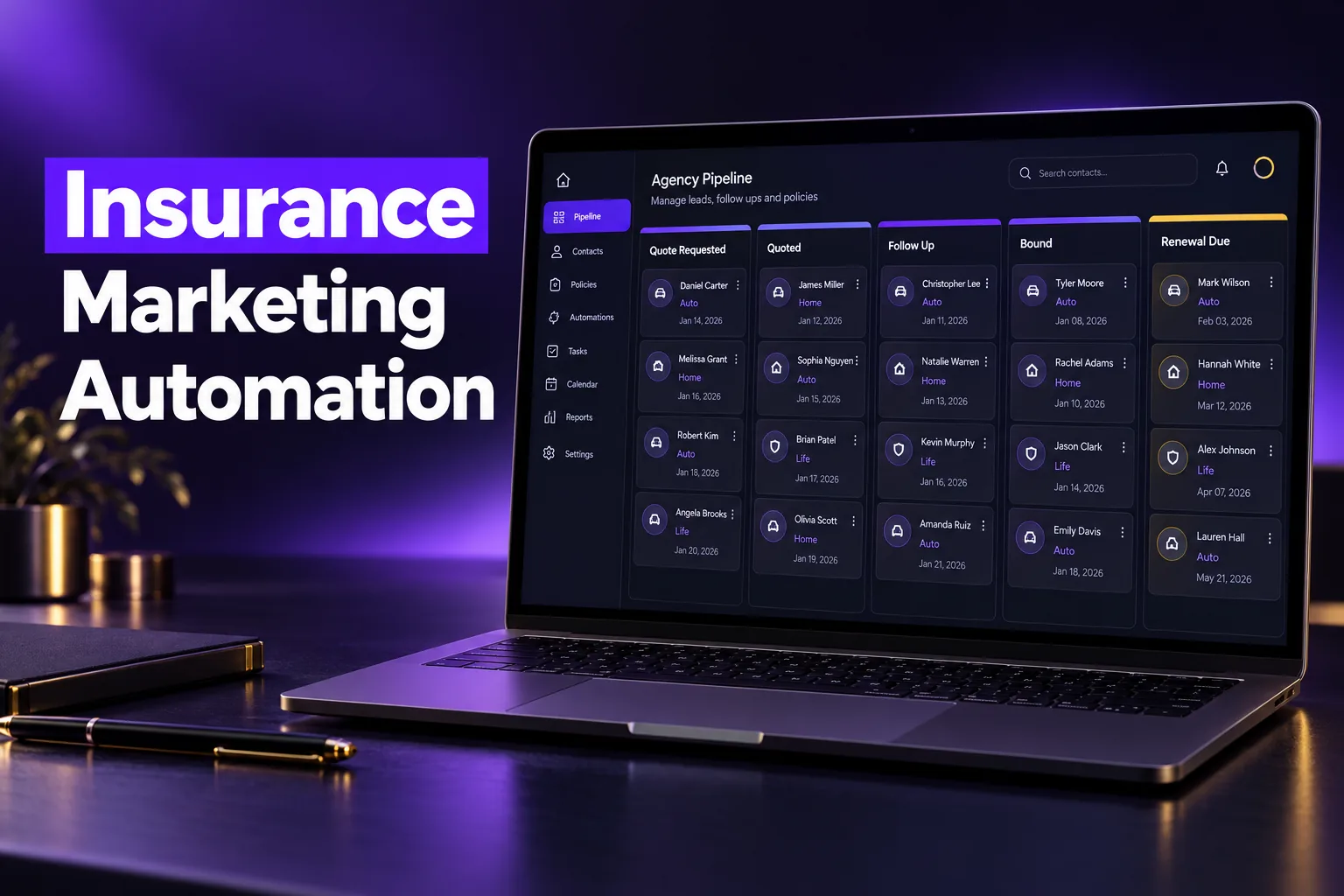
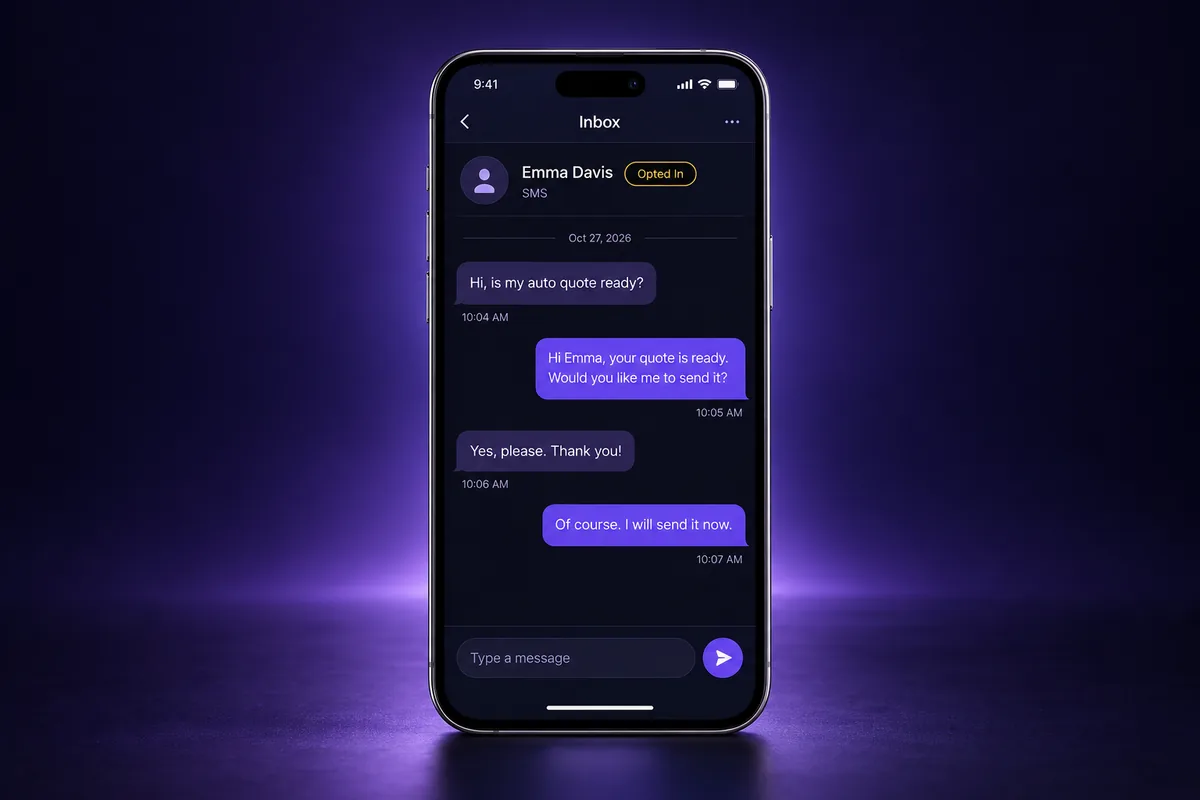
Automated quote follow-up in insurance marketing automation moves every quote through a pipeline and sends a timed sequence of texts, emails and call reminders until the prospect binds, says no or stops replying. Any reply pauses the sequence and alerts the producer, so the conversation stays personal.
A clean quote pipeline in GoHighLevel usually has stages like these:
| Stage | What the system does | What the producer does |
|---|---|---|
| New lead | Sends an instant reply and creates a call task | Calls and gathers rating details |
| Quoting | Reminds the producer if the quote is overdue | Runs the comparison |
| Quote sent | Follows up by text and email over the next days | Answers questions on coverage |
| Bound | Sends a welcome message and a review request later | Completes the policy in the AMS |
| Not now | Moves the lead into a long-term nurture list | Re-quotes when the client is ready |
Two settings matter more than the message copy. First, stop on reply, so nobody gets a scripted text after asking a real question. Second, tag the line of business (auto, home, life, health, commercial), because each line needs different follow-up and different compliance care.
How do renewal and retention campaigns work?
Renewal and retention campaigns use insurance marketing automation to contact clients before their policy renews, explain any change and offer a review. Reaching out early, instead of waiting for the carrier notice, gives the agency time to re-shop a rate increase before the client starts shopping on their own.
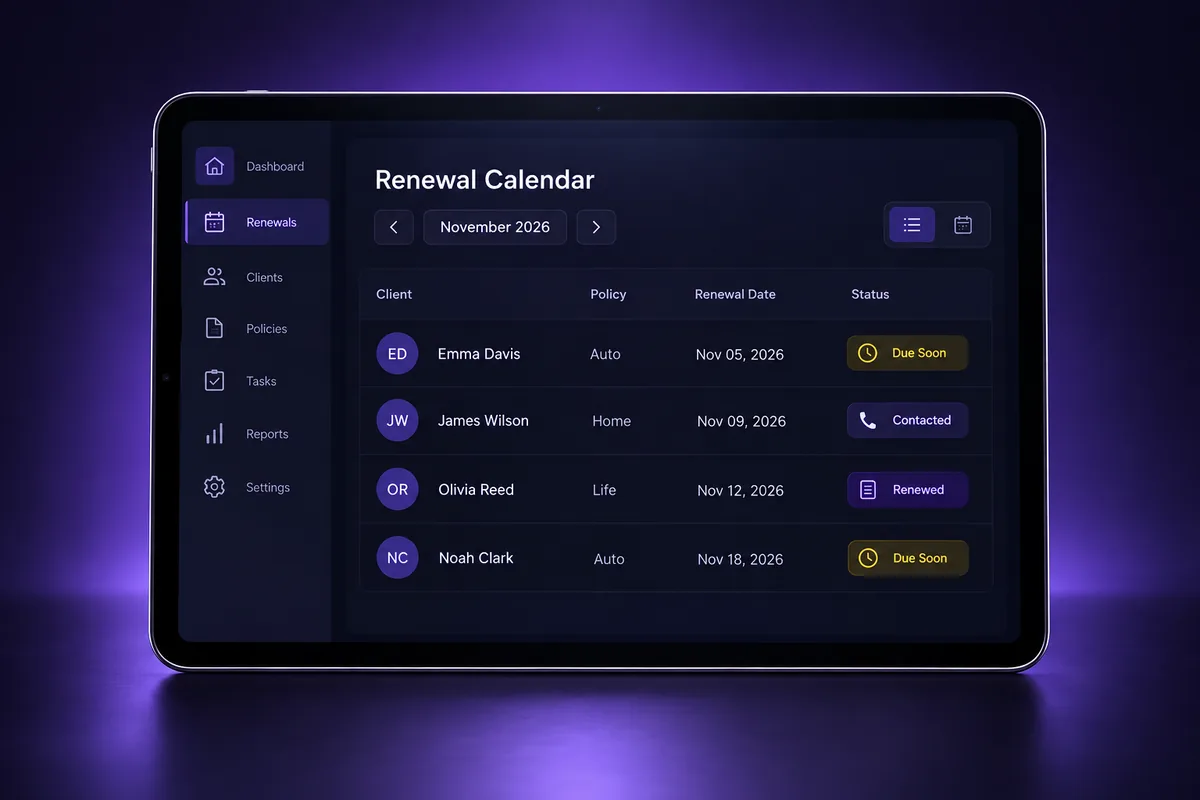
- Renewal dates as data: store the renewal or expiration date in a custom date field on the contact or opportunity. Automation can only remind clients about dates it actually knows.
- Personal check-in: a short, plain text from the agent before renewal often gets more replies than a long email.
- Rate review offers: when premiums rise, an offer to re-shop shows the client you are watching the account.
- Life events: new car, new home, new driver or a new business all change coverage needs. A yearly check-in asks about them.
- Payment and lapse risk: if your carrier or AMS reports missed payments, those contacts need a quick, human call, not a marketing message.
How does automation help with cross-sell and referrals?
Insurance marketing automation helps cross-sell by finding clients who hold one line with the agency and sending them a relevant offer for a missing line, such as home with auto or umbrella with both. Referral and review requests then go to satisfied clients at natural moments, like after a smooth claim or a renewal.
- Segment by line: tags or custom fields for each policy type let Smart Lists show “auto only” or “no life policy” clients in seconds.
- One offer at a time: a single relevant message beats a newsletter listing every product you sell.
- Reviews: GoHighLevel’s Reputation Management sends review requests and tracks Google Business Profile reviews in the same account.
- Referrals: a simple ask with a form link, sent after a positive moment, keeps the source tracked in the CRM.
What compliance rules apply to insurance texting and calls?
Insurance texting and calling in the US is shaped by the Telephone Consumer Protection Act (TCPA), carrier A2P 10DLC registration for business texting, state telemarketing laws and your state insurance department’s record rules. Health insurance data can also fall under HIPAA. Automation must respect consent and opt-outs on every message.
- Consent: capture clear consent on your quote forms and store it with the contact. In January 2025 the Eleventh Circuit vacated the FCC’s “one-to-one consent” rule in Insurance Marketing Coalition v. FCC, but the TCPA’s own consent requirements still apply. Treat purchased or shared leads with extra care.
- A2P 10DLC: texting from a local 10-digit number requires brand and campaign registration with The Campaign Registry through your provider. Our GoHighLevel A2P 10DLC registration guide covers what carriers check.
- Opt-outs and quiet hours: honor STOP replies immediately and keep sending windows inside the hours your state allows. Some states set stricter calling hours than federal rules.
- Record keeping: agencies that sell securities products such as variable annuities may face FINRA and SEC archiving rules. Our guide to GoHighLevel text message archiving explains the options.
- Health data: if you handle protected health information, read our GoHighLevel HIPAA compliance guide before you put it in any CRM.
This is general information, not legal advice. Have your compliance contact or attorney review your consent language and sending rules.
How does marketing automation fit with your agency management system?
Insurance marketing automation usually sits next to an agency management system (AMS), not in place of it. The AMS, such as Applied Epic, EZLynx or HawkSoft, stays the record for policies, carriers and commissions, while the CRM handles leads, messaging, pipelines and campaigns before and around the sale.
| Job | Agency management system | Marketing automation CRM |
|---|---|---|
| Policy records, carriers, commissions | Yes, the system of record | No |
| Lead capture and instant replies | Limited | Yes |
| Quote pipelines and follow-up | Varies | Yes |
| Two-way texting, calls, email campaigns | Varies | Yes |
| Reviews, referrals, landing pages | Rarely | Yes |
The link between the two is usually the renewal date and policy type. Some agencies export a renewal list from the AMS on a schedule. Others connect the systems through Zapier, webhooks or the GoHighLevel API. Decide which system owns each field before you sync anything, or you will overwrite good data.
If you are still choosing a platform, our comparison of the best CRMs for insurance agents looks at the main options side by side.
Which tools do insurance agencies use for marketing automation?
Insurance agencies use three kinds of tools for marketing automation: all-in-one platforms such as GoHighLevel, insurance-specific CRMs built around policies and producers, and general email tools. The right pick depends on whether you need texting, calls and pipelines in one place or only email newsletters.
- All-in-one (GoHighLevel): CRM, pipelines, two-way SMS, calls, email, forms, landing pages, Conversation AI, Voice AI and review requests in one account. It is not insurance-specific out of the box, so it needs pipelines, fields and campaigns built for your lines.
- Insurance-specific CRMs: built around policies and producers, often with carrier or AMS links. Check what they cost per user and how much texting they really support.
- Email-only tools: fine for a monthly newsletter, but they leave speed-to-lead and quote follow-up to the producer.
GoHighLevel plans start at $97 per month, with texts, calls and email billed by usage on top. Count the one-time A2P registration fees and the setup work, whether that is your time or a done-for-you build.
What mistakes break insurance marketing automation?
The mistakes that break insurance marketing automation are almost always setup problems: missing consent records, no stop-on-reply rule, renewal dates that were never imported, and one generic sequence for every line of business. Each one either annoys clients or quietly stops the system from working.
- Texting before A2P approval. Unregistered traffic gets filtered, and the agency thinks leads stopped replying.
- No consent field. If you cannot show when and how a contact agreed to messages, you carry the risk.
- Sequences that never stop. A client who just bound a policy should not get another “still shopping?” text.
- Dirty imports. Duplicate contacts and missing renewal dates make every campaign wrong from day one.
- Too much automation for life and health. These lines need careful, personal conversations. Use automation to book them, not to sell.
Quotes going cold before anyone follows up?
If internet leads wait hours, quotes die after one voicemail and renewals catch clients by surprise, the problem is the system, not your producers. Insurance marketing automation only works when lead capture, pipelines, consent and renewal data are connected properly.
We build it for independent and captive agencies: quote pipelines, instant replies, renewal reminders, cross-sell lists and review requests, with A2P registration handled. See our done-for-you GoHighLevel setup for insurance agencies, or start with our general GoHighLevel setup service.
Frequently Asked Questions
What can insurance agents automate?
Insurance agents can automate first replies to new leads, quote follow-up reminders, appointment booking, renewal check-ins, cross-sell offers for missing lines, review requests, referral asks and birthday or policy-anniversary messages. The coverage advice itself should stay with a licensed person. Automation books the conversation and keeps it on schedule.
Is GoHighLevel good for insurance agencies?
GoHighLevel is a good fit for insurance agencies that want lead capture, two-way texting, calls, email, pipelines, AI replies and review requests in one account. It does not replace an agency management system for policies and commissions. It needs insurance pipelines, custom fields for lines and renewal dates, and registered texting to work well.
How much does insurance marketing automation cost?
Insurance marketing automation costs a platform subscription plus usage fees. GoHighLevel starts at $97 per month, with SMS, calls and email billed by usage. Insurance-specific CRMs usually charge per user. Add one-time A2P 10DLC registration fees and the setup cost, either your own hours or a done-for-you build from an implementation agency.
Can insurance agents text leads?
Yes, insurance agents can text leads who gave consent, as long as the number is registered for A2P 10DLC or verified as toll-free, and every message honors opt-outs. Store how and when each contact agreed. Be careful with purchased or shared leads, and keep sending inside the hours your state allows.
Does marketing automation replace an agency management system?
No, marketing automation does not replace an agency management system. The AMS keeps policies, carriers, endorsements and commissions. The marketing automation CRM handles leads, quotes in progress, messaging, reviews and campaigns. Most agencies run both and sync a few fields, such as renewal date and policy type, between them.
Can AI answer insurance leads?
AI can answer insurance leads by text, chat or phone, collect basic details such as the line of business and current carrier, and book a quote call. GoHighLevel’s Conversation AI and Voice AI do this inside the CRM. Set clear limits so the AI never gives coverage or pricing advice, and hand off to a licensed agent.
Ready to Get Your GoHighLevel System Built?
We'll build your entire GHL setup for $499 and give you a free professional website.
Book a Free Call See Packages & PricingOr call +1 (681) 276-7045 · Mon–Fri, 9 AM–5 PM ET