

Ready to Try GoHighLevel?
Get the all-in-one platform for CRM, automations, funnels & websites — built for agencies.
Start your free trial and explore every feature.
A HubSpot to GoHighLevel migration is not one job. It is two.
The first job is data. Contacts, companies, deals, and notes. That part is mostly mechanical and it goes fine if you prepare properly.
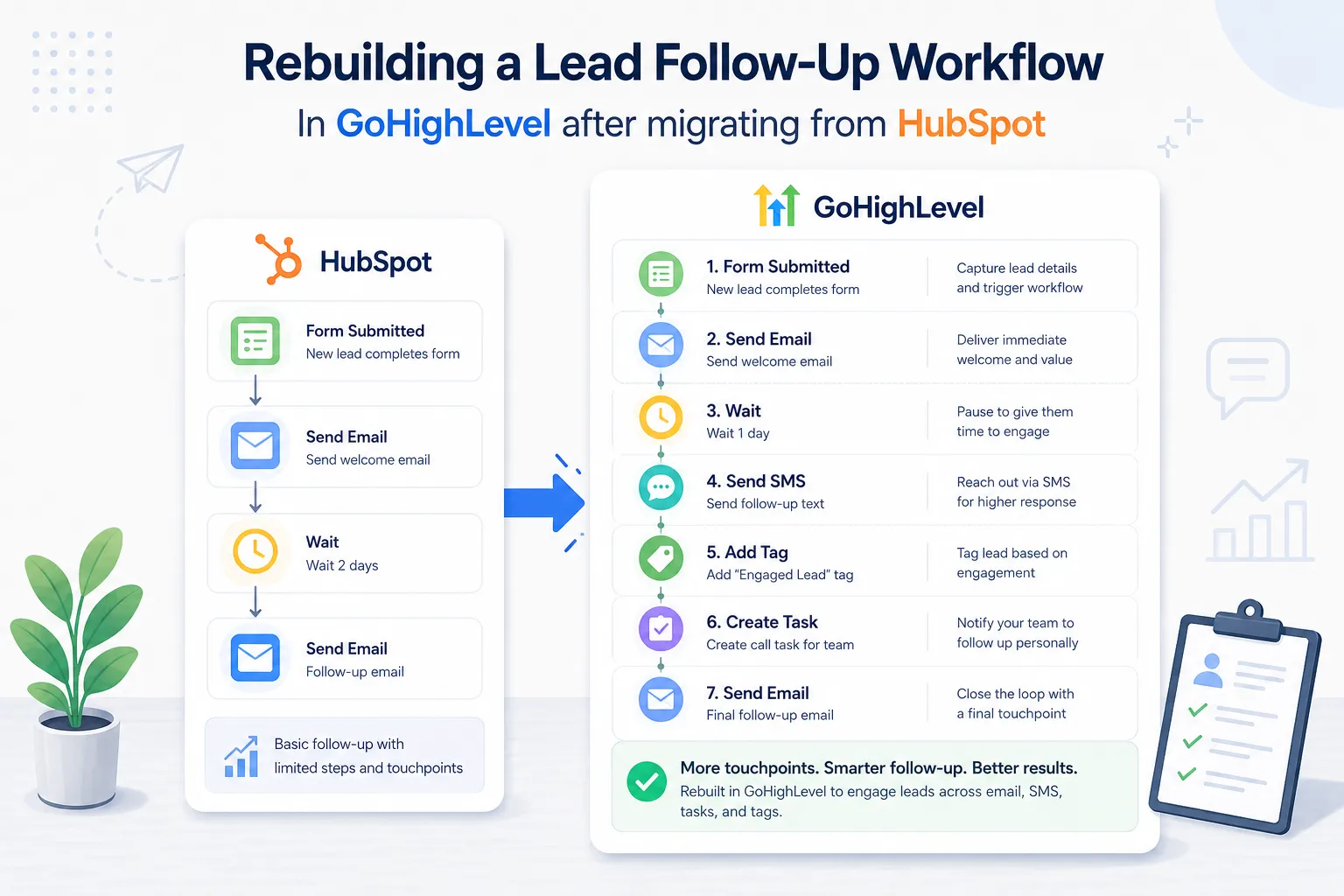
The second job is everything HubSpot will not let you export. Workflows, sequences, forms, landing pages, and email templates cannot be carried across as files. They have to be rebuilt inside GoHighLevel.
People who understand this before they start have a smooth HubSpot to GoHighLevel migration. People who do not are the ones posting at 2am asking where their automations went. This guide covers the whole process, using the official documented behaviour of both platforms.
What actually moves in a HubSpot to GoHighLevel migration
Moves as data: contacts, companies, deals, tickets, custom objects, and the custom field values attached to them. The official HubSpot exports documentation confirms you can export standard and custom objects, and include up to four associated objects in one export so related records travel together.
Does not move: workflows, sequences, email templates, forms, landing pages, reports, dashboards, and meeting links. None of these export in a format another CRM can read. Every one of them is a rebuild.
That second list is where the real work sits. Budget your time accordingly. The export is an afternoon. The rebuild is the project.
Why teams start a HubSpot to GoHighLevel migration at all
It helps to be clear about the reason, because it shapes what you rebuild.
Most moves happen for one of three reasons. Cost, because HubSpot pricing climbs quickly as contact counts and seats grow. Consolidation, because the business is paying separately for texting, booking, funnels, and review requests that GoHighLevel includes in one login. Or client work, because agencies want to give every client the same system under their own brand.
If cost is your reason, rebuild only what you use and keep the system lean. If consolidation is your reason, your migration also means switching off other tools, so plan those cancellations too. If client work is your reason, build the system once as a snapshot and reuse it, instead of rebuilding by hand for every client.
Knowing your reason stops your HubSpot to GoHighLevel migration from copying the old system exactly. You are not trying to recreate the old system. You are trying to end up with a better one.
Prepare these four things before any HubSpot to GoHighLevel migration
Do not touch the export button yet.
1. Decide what you actually need. Most HubSpot accounts carry years of dead records. Contacts who never replied, deals lost in 2021, duplicate companies. Migrating rubbish costs you nothing in fees and everything in clarity. Decide your cutoff date now.
2. List your custom fields. Write down every custom property in HubSpot that you actually use. You will need to create the matching fields in GoHighLevel before importing, because unmapped columns are simply ignored during import.
3. Screenshot your automations. Open every workflow and sequence you rely on and capture what it does. Trigger, wait times, conditions, and messages. This becomes your rebuild plan.
4. Pick your GoHighLevel plan. The official HighLevel pricing page lists Starter at $97 a month, Unlimited at $297 a month, and Agency Pro at $497 a month, with a 14 day free trial. Sub account needs and API access differ between them, so choose before you build, not after.
Step 1: Export your data from HubSpot
Export each object separately. Contacts first, then companies, then deals, then anything custom.
HubSpot offers XLSX, CSV, and XLS formats. Choose CSV, because that is what GoHighLevel imports.
A few documented limits are worth knowing before you begin. You can complete up to thirty exports in a rolling 24 hour window, and only one export runs at a time. Very large exports get split automatically into multiple files inside a zip archive. The download link that HubSpot returns expires after five minutes, so download it as soon as it is ready.
By default each row carries up to 1,000 associations, which is far more than most businesses need, but worth knowing if you have unusually connected records.
Step 2: Clean the file before your HubSpot to GoHighLevel migration
This is the step that decides whether your HubSpot to GoHighLevel migration ends in a clean CRM or a mess.
- Delete rows with no name, no email, and no phone number, because GoHighLevel needs at least one of those three to create a contact
- Strip brackets, spaces, and letters out of phone numbers
- Fix the country code format so every number is consistent
- Remove duplicate rows inside the file itself
- Rename your column headers to plain words that match your GoHighLevel fields
- Split the file if it is over 30 MB, which is the import size limit
Save it as a CSV with one sheet only, and make sure the first row is your header row and is not blank.
Step 3: Build your custom fields first
Go into GoHighLevel settings and create every custom field you listed earlier, before you import anything.
If a field does not exist, the column will be ignored and that data is gone from the import. You would then have to re import to fix it, which creates duplicates. Ten minutes here saves hours later.
Step 4: Import your contacts
Only an administrator can run an import, according to the official HighLevel import guide, so make sure you have the right access.
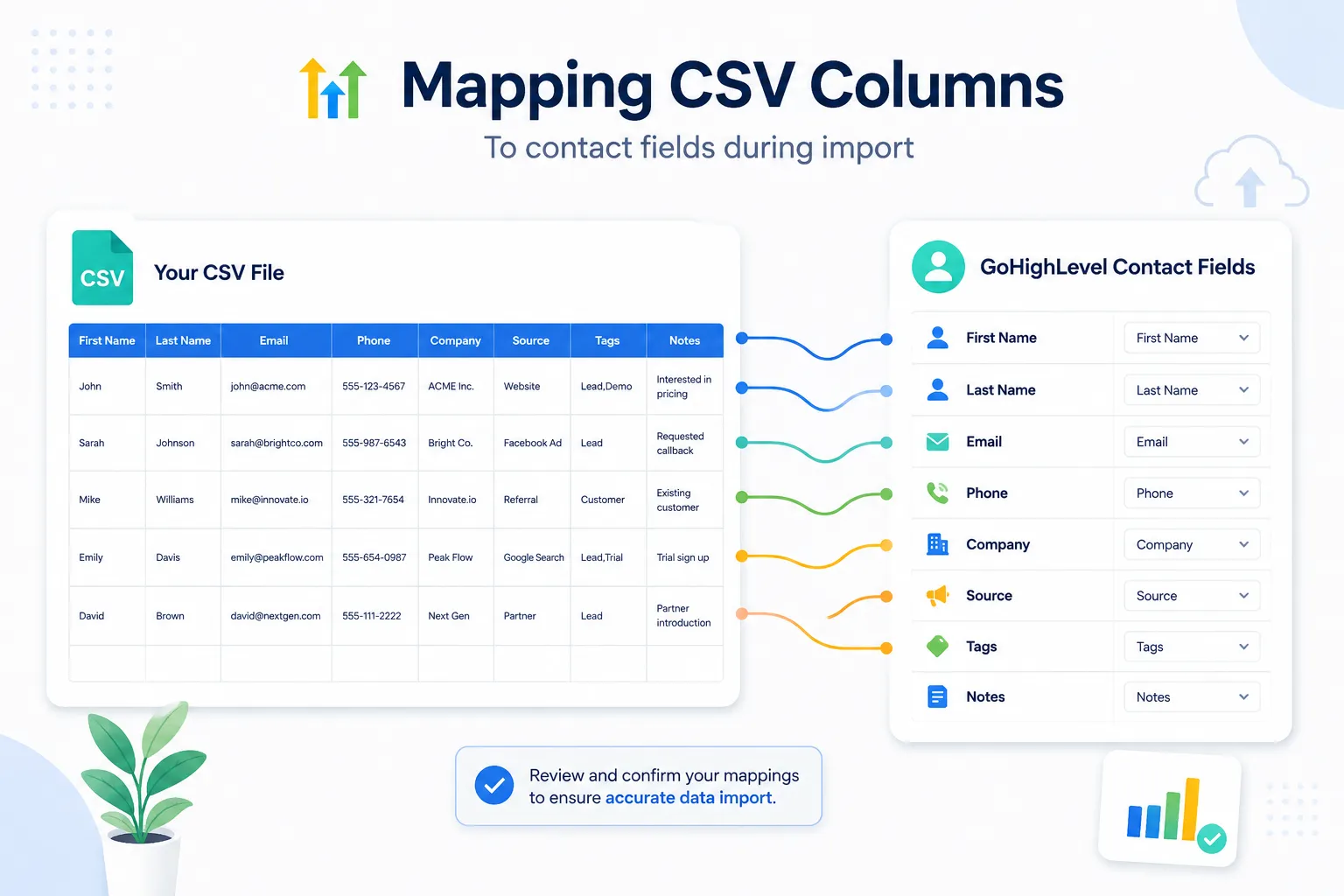
Open Contacts, choose Import Contacts, and select whether you are importing contacts only or contacts with opportunities. Upload your CSV, choose whether you are creating new records or updating existing ones, then map each column to the matching GoHighLevel field.
Two settings matter here. Duplicates are matched in a set order: Contact ID first, then email, then phone. And if you are updating existing records, turn on the option that stops empty values overwriting good data. Without it, a blank cell can wipe a field that already had something useful in it.
Review the mapping screen carefully before you confirm. This is the last easy moment to catch a mistake.
Step 5: Rebuild what a HubSpot to GoHighLevel migration cannot carry
Now open your screenshots and rebuild, in this order.
Pipelines first. Recreate your deal stages so imported opportunities have somewhere sensible to land.
Forms and calendars second. These are how new leads enter the system, so they need to work before anything else.
Workflows third. Start with the one that follows up a new lead. That single automation usually carries most of the value. Add the rest once it is tested.
Templates last. Copy your email and text wording across and rewrite anything that referenced HubSpot features that do not exist here.
Resist the urge to rebuild everything. Most teams find that a third of their old HubSpot workflows were never really used. Migration is a good moment to leave those behind.
Step 6: Do not switch off HubSpot yet
The safest HubSpot to GoHighLevel migration runs both systems side by side for at least two weeks.
During that time, send a real lead through your new forms and watch it travel all the way to a booked appointment. Check that emails arrive in inboxes and not spam. Confirm your A2P 10DLC registration is approved before you rely on text messages, because carriers block unregistered traffic.
Compare contact counts between the two systems. If GoHighLevel has fewer records than expected, find out why before you cancel anything.
Export one final backup from HubSpot and store it somewhere safe. Once that subscription ends, the data is not coming back.
How long a HubSpot to GoHighLevel migration takes
A small business with a few thousand contacts and five workflows takes about one to two weeks.
A larger account with custom objects, tens of thousands of records, and heavy automation takes four to six weeks.
The exporting and importing is rarely more than a day of that. Everything else is the rebuild and the testing.
HubSpot to GoHighLevel migration mistakes that cause data loss
- Importing before creating custom fields, so the values silently disappear
- Letting empty cells overwrite existing data during an update import
- Cancelling HubSpot before the new system has been tested with live leads
- Importing the same file twice to fix a mistake, which creates duplicates
- Turning on automated messages before A2P registration is approved
Every one of these is common and every one is avoidable.
When it makes sense to get help
If your data is simple and your automations are few, run the HubSpot to GoHighLevel migration yourself. The steps above are enough.
Get help when you have custom objects, more than about twenty thousand records, complex deal logic, or a team that cannot afford a single day of downtime. In those cases the cost of a mistake is far higher than the cost of the service. You can see how we scope this work on our GHL migration services page.
Your next step
Start with the boring part. Open HubSpot, list your custom properties, and screenshot your workflows. That single hour turns a stressful HubSpot to GoHighLevel migration into a simple checklist.
Then export, clean, build your fields, and import in that order. If you would rather have it done and tested for you, our team handles the whole move, including the rebuild. You can also read our guide to GoHighLevel setup mistakes to avoid the errors that show up right after a migration.
Ready to Get Your GoHighLevel System Built?
We'll build your entire GHL setup for $499 and give you a free professional website.
Contact Us Now
Pingback: Zoho to GoHighLevel Migration: The Best 2026 Guide
Pingback: ActiveCampaign to GoHighLevel Migration: The Best Complete Guide 2026
Pingback: Kajabi to GoHighLevel Migration: The Best 2026 Guide
Pingback: Kartra to GoHighLevel Migration: The Best 2026 Guide
Pingback: GoHighLevel Migration Service: The Best 2026 Walkthrough
Pingback: GoHighLevel CRM Data Migration Service: Best 2026 Guide