Ready to Try GoHighLevel?
Get the all-in-one platform for CRM, automations, funnels & websites — built for agencies.
Start your free trial and explore every feature.
GoHighLevel SMS pricing is usage-based, not flat-rate. Your subscription plan ($97, $297, or $497) does not include unlimited texting. SMS bills at approximately $0.0079 per segment for US/Canada through LC Phone, plus carrier fees per message, plus monthly A2P campaign fees. Costs vary by country, route, carrier, and message format. HighLevel posted route pricing updates effective May 13, 2026, and US carrier fees increased (AT&T April 1, 2026; Verizon May 1, 2026). This guide covers the full breakdown including the hidden costs most articles miss: carrier fees per segment, monthly campaign fees, number validation fees, and the May 2026 international route increases.
You opened your GoHighLevel bill and the SMS charges were higher than you expected. Or your messages started getting blocked. Or you’re trying to budget before you go live and want to know what SMS will actually cost.
Here’s the honest answer: GoHighLevel SMS pricing is not one number. It’s a stack of charges that includes the base SMS rate, carrier fees, A2P campaign fees, monthly campaign fees, and country/route variations, and for GHL agencies managing multiple client accounts, these costs can add up quickly if you are not tracking them from day one.
The “$0.0079 per segment” you see in most articles is only the LC Phone base rate for US/Canada. Real total cost is usually 30 to 60 per cent higher once you add carrier fees and A2P costs.
This guide breaks down everything: base rates, carrier fees, A2P fees, the May 2026 pricing updates, international rates, and how to actually reduce costs without hurting performance.
How GoHighLevel SMS Pricing Actually Works
GoHighLevel uses a usage-based pricing model. You pay your subscription separately, then pay per-message charges on top.
The full SMS cost is a stack of three things:
- LC Phone base rate (Twilio passthrough)
- Carrier fees per segment (set by AT&T, T-Mobile, Verizon)
- A2P fees (one-time registration plus monthly campaign fees)
Most pricing articles only show #1. The real cost includes all three.
HighLevel passes carrier and A2P fees through with no markup. The LC Phone base rate matches Twilio pricing. There is no profit margin on usage charges (HighLevel makes money on the subscription, not on SMS).
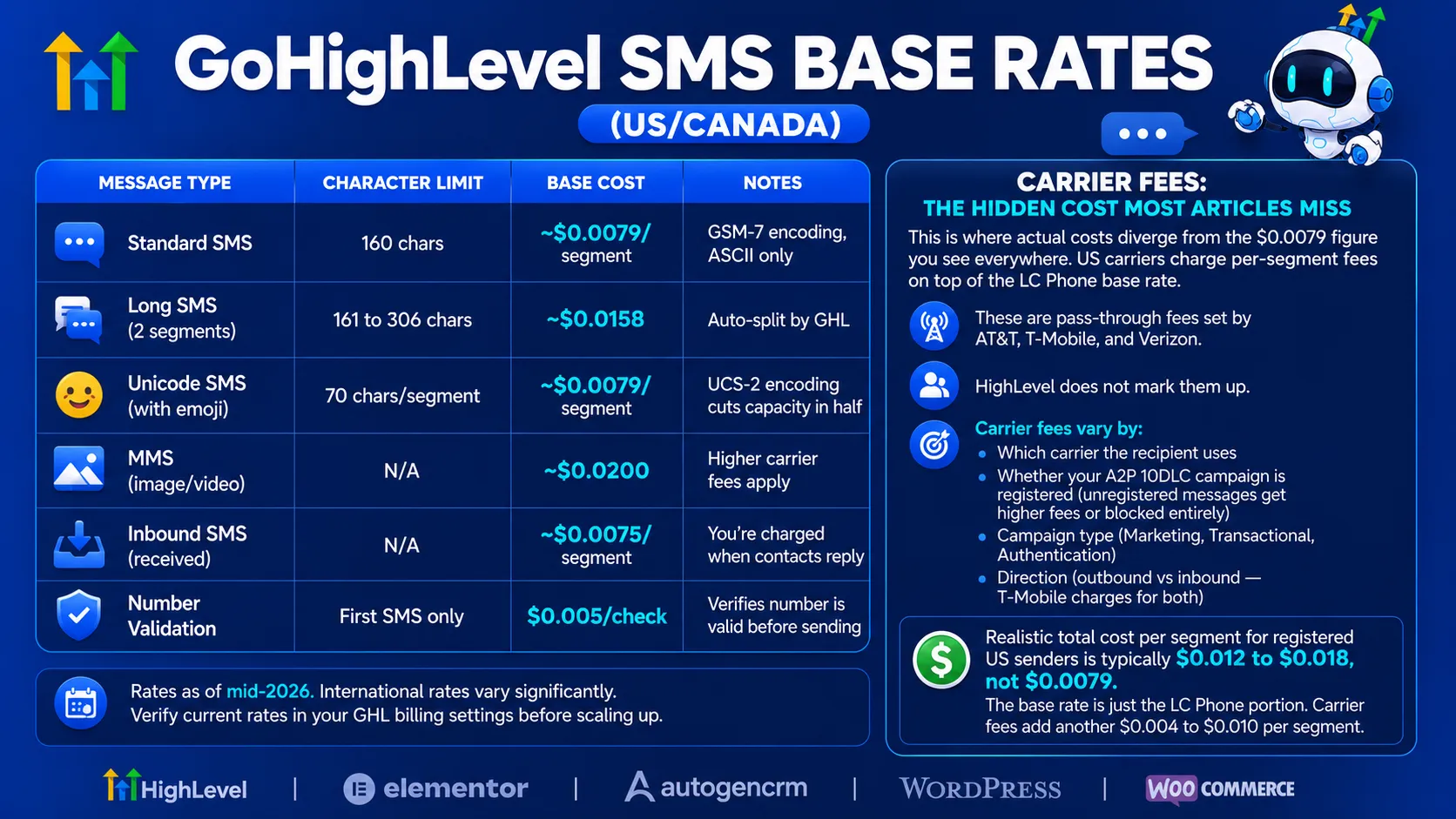
GoHighLevel SMS Base Rates (US/Canada)
| Message Type | Character Limit | Base Cost | Notes |
|---|---|---|---|
| Standard SMS | 160 chars | ~$0.0079/segment | GSM-7 encoding, ASCII only |
| Long SMS (2 segments) | 161 to 306 chars | ~$0.0158 | Auto-split by GHL |
| Unicode SMS (with emoji) | 70 chars/segment | ~$0.0079/segment | UCS-2 encoding cuts capacity in half |
| MMS (image/video) | N/A | ~$0.0200 | Higher carrier fees apply |
| Inbound SMS (received) | N/A | ~$0.0075/segment | You’re charged when contacts reply |
| Number Validation | First SMS only | $0.005/check | Verifies number is valid before sending |
Rates as of mid-2026. International rates vary significantly. Verify current rates in your GHL billing settings before scaling up.
Carrier Fees: The Hidden Cost Most Articles Miss
This is where actual costs diverge from the $0.0079 figure you see everywhere.
US carriers charge per-segment fees on top of the LC Phone base rate. These are pass-through fees set by AT&T, T-Mobile, and Verizon. HighLevel does not mark them up.
Carrier fees vary by:
- Which carrier the recipient uses
- Whether your A2P 10DLC campaign is registered (unregistered messages get higher fees or blocked entirely)
- Campaign type (Marketing, Transactional, Authentication)
- Direction (outbound vs inbound, T-Mobile charges for both)
Realistic total cost per segment for registered US senders is typically $0.012 to $0.018, not $0.0079. The base rate is just the LC Phone portion. Carrier fees add another $0.004 to $0.010 per segment.
2026 US Carrier Fee Increases
Two important updates affect 2026 SMS budgets:
- AT&T carrier fees increased April 1, 2026.
- Verizon carrier fees increased May 1, 2026.
Per-message costs for US senders are slightly higher than historical rates from these dates forward. If you budgeted your SMS spend based on early 2025 numbers, your actual costs in 2026 will run 5 to 15 percent higher.
A2P 10DLC Costs (Required for US Business SMS)
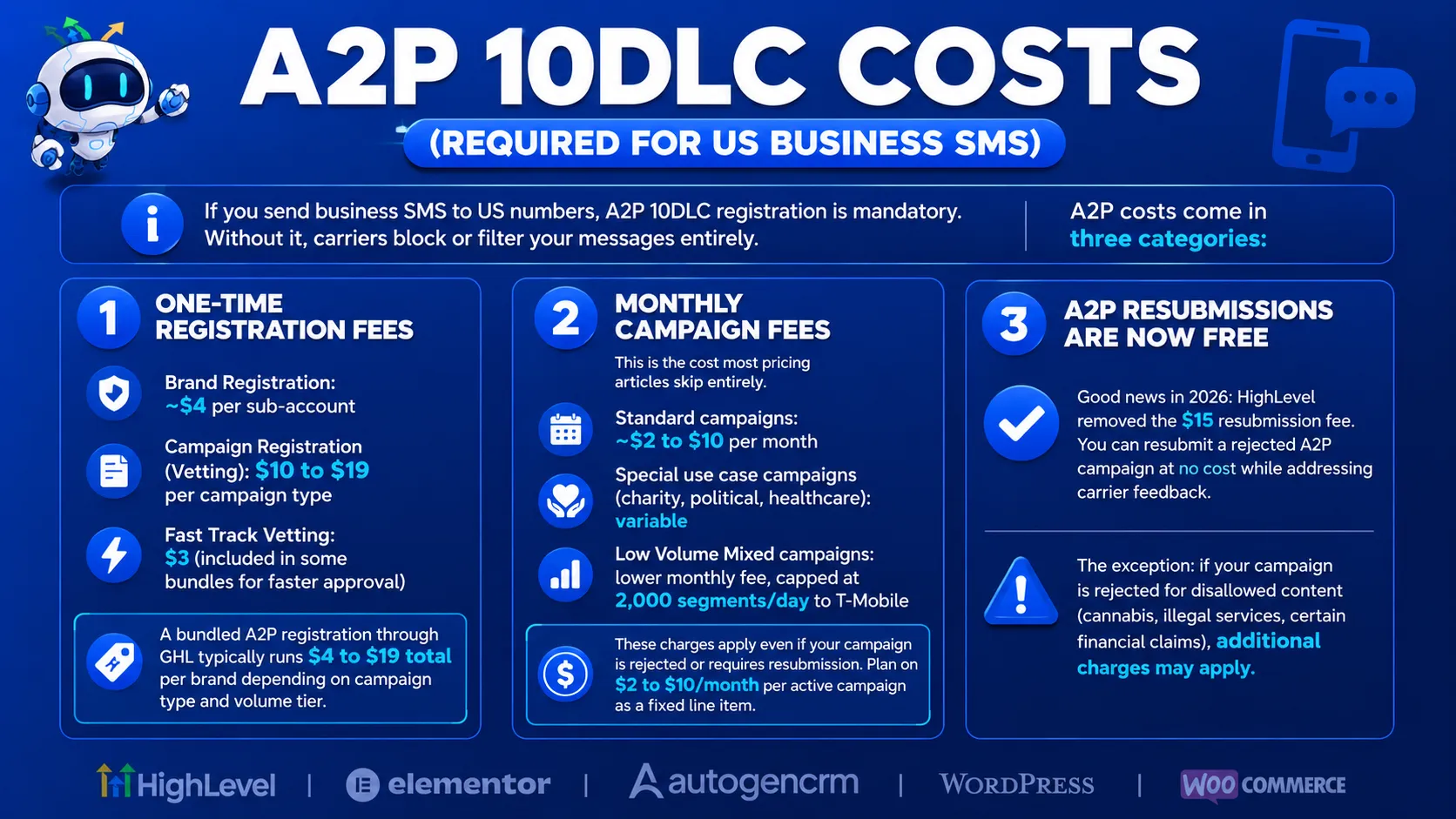
If you send business SMS to US numbers, A2P 10DLC registration is mandatory. Without it, carriers block or filter your messages entirely.
A2P costs come in three categories:
1. One-Time Registration Fees
- Brand Registration: ~$4 per sub-account
- Campaign Registration (Vetting): $10 to $19 per campaign type
- Fast Track Vetting: $3 (included in some bundles for faster approval)
A bundled A2P registration through GHL typically runs $4 to $19 total per brand depending on campaign type and volume tier.
2. Monthly Campaign Fees
This is the cost most pricing articles skip entirely.
The Campaign Registry (TCR) charges recurring monthly fees per registered campaign. Typical fees:
- Standard campaigns: ~$2 to $10 per month
- Special use case campaigns (charity, political, healthcare): variable
- Low Volume Mixed campaigns: lower monthly fee, capped at 2,000 segments/day to T-Mobile
These charges apply even if your campaign is rejected or requires resubmission. Plan on $2 to $10/month per active campaign as a fixed line item.
3. A2P Resubmissions Are Now Free
Good news in 2026: HighLevel removed the $15 resubmission fee. You can resubmit a rejected A2P campaign at no cost while addressing carrier feedback. This was a meaningful change because rejection rates on first submissions are high (especially for marketing campaigns).
The exception: if your campaign is rejected for disallowed content (cannabis, illegal services, certain financial claims), additional charges may apply.
The May 2026 High-Level Pricing Update
HighLevel published a pricing update on May 13, 2026 affecting certain SMS and Voice routes due to underlying carrier partner changes.
The update primarily affects international routes. Some examples of routes with increases:
- St. Lucia (Mobile): $0.5040 → $0.7158 per segment
- Various other Caribbean and Latin American mobile routes saw similar percentage increases
- Several voice call routes also adjusted
If you send international SMS or make international calls, check your specific country rates in the LC Phone Pricing Guide before assuming old rates still apply.
A separate phone number and messaging discount update went into effect May 6, 2026, providing some price reductions on specific number types.
International SMS Pricing
GoHighLevel SMS pricing varies dramatically by country because LC Phone passes through Twilio rates. Some examples of base rate ranges:
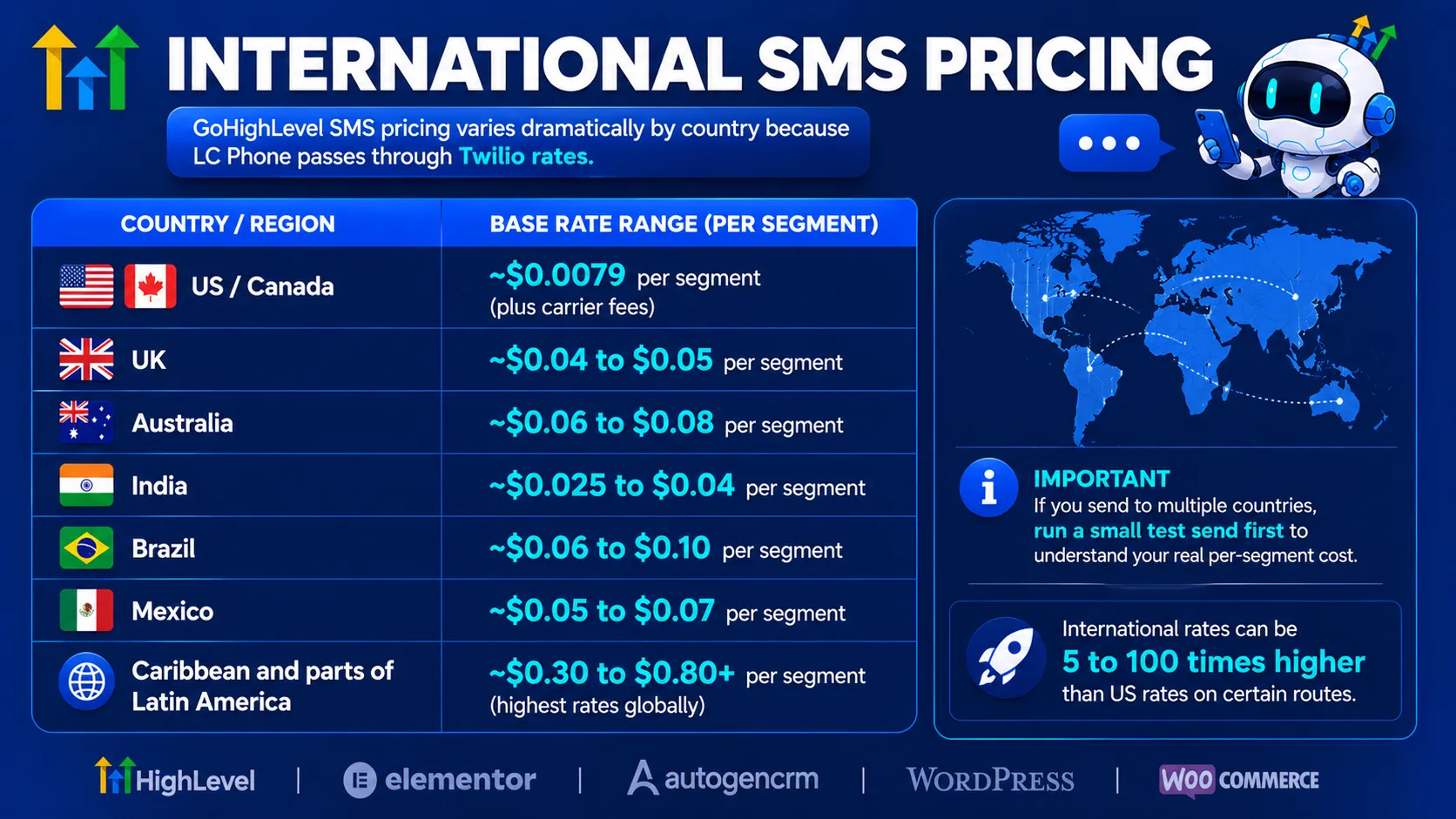
- US/Canada: ~$0.0079 per segment (plus carrier fees)
- UK: ~$0.04 to $0.05 per segment
- Australia: ~$0.06 to $0.08 per segment
- India: ~$0.025 to $0.04 per segment
- Brazil: ~$0.06 to $0.10 per segment
- Mexico: ~$0.05 to $0.07 per segment
- Caribbean and parts of Latin America: $0.30 to $0.80+ per segment (highest rates globally)
If you send to multiple countries, run a small test send first to understand your real per-segment cost. International rates can be 5 to 100 times higher than US rates on certain routes.
How to Calculate Your Real GoHighLevel SMS Cost
For US senders with proper A2P registration, use this formula:
Total cost per segment = LC Phone base rate + Carrier fee per segment
Realistic example for a registered US Marketing campaign in mid-2026:
- LC Phone base rate: $0.0079
- Carrier fee (varies by carrier): $0.005 to $0.010
- Total per segment: $0.013 to $0.018
For a 1-segment SMS to 1,000 US contacts:
- Variable cost: $13 to $18
- Plus monthly campaign fee: ~$2 to $10/month flat
- Plus number validation on first sends: ~$5 (one-time per number)
Total real cost for that 1,000-message send is closer to $20 to $30, not the $7.90 the base rate alone suggests.
How to Complete A2P 10DLC Registration in GoHighLevel
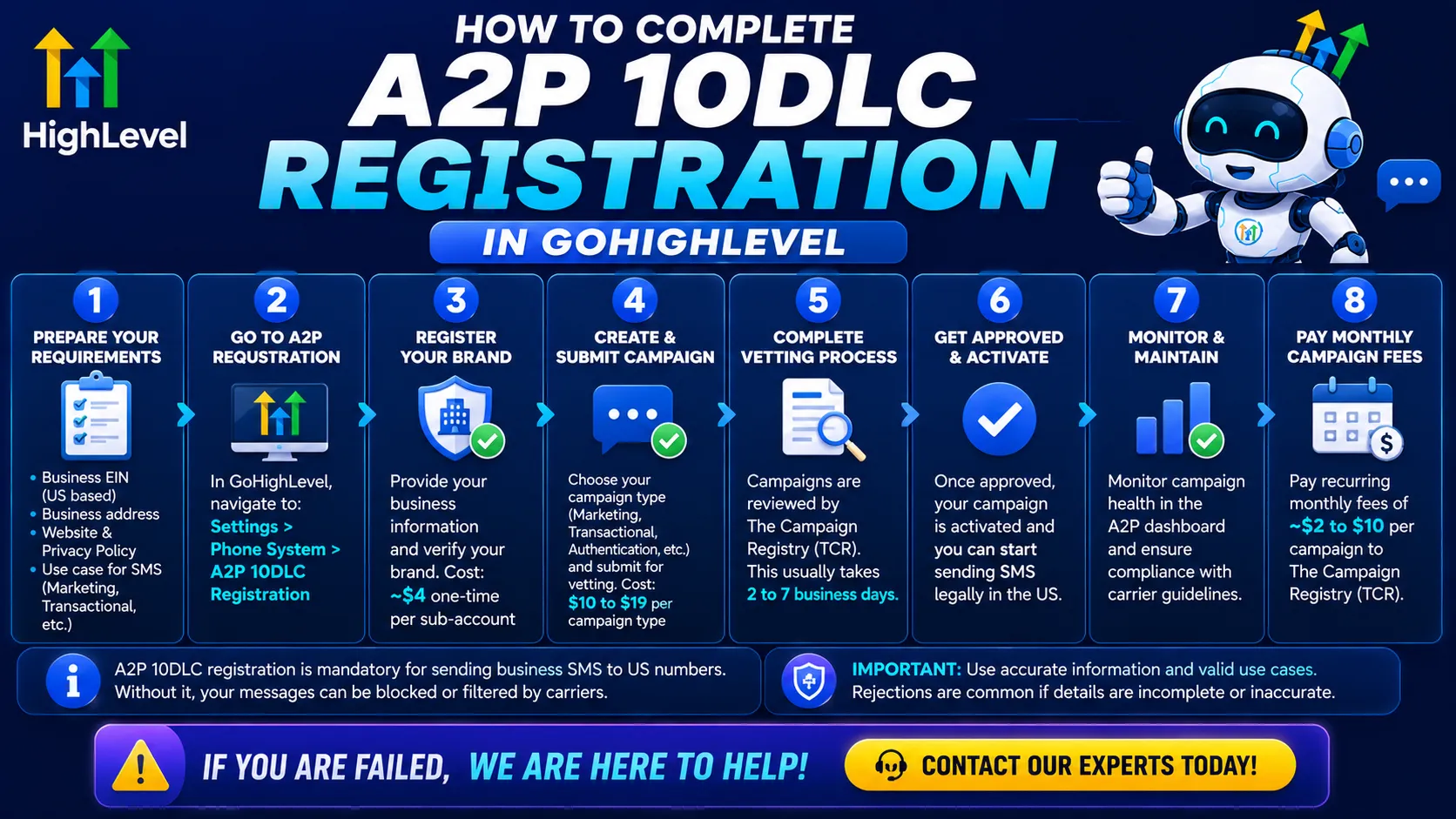
- Go to Sub-Account → Phone Numbers → LC Phone → A2P Compliance (or Trust Center)
- Brand Registration: Enter legal business name, EIN/Tax ID, business type, business address, website URL. Submit and wait 3 to 5 days for approval.
- Campaign Registration: After Brand approval, create a Campaign. Select type: Marketing, Transactional, or Authentication. Write the opt-in message and campaign description. Submit and wait 3 to 7 days.
- Verify both Brand and Campaign show “Approved” before sending volume SMS.
Critical: Avoid These A2P Description Triggers
Carriers auto-reject A2P campaign descriptions containing certain phrases. Avoid these in the campaign description (the message content is separate):
- “Free,” “guaranteed,” “no risk”
- “Marketing” (in the description)
- “Limited time”
- Cannabis, CBD, kratom references
- Specific financial claim language
- Adult content or alcohol references
- Loan or debt forgiveness phrasing
Write the campaign description as an operational statement: “We send appointment reminders and service follow-up messages to customers who have opted in through our website intake form or in-person visits.”
If You Send Reminders Only
Register under the Transactional campaign type. Faster approval, lower rejection rates, lower carrier fees per segment. Keep your SMS content strictly operational (appointments, order updates, account notifications). No promotional offers.
If You Send Promotional Messages
Register under Marketing. Higher carrier fees per segment but lets you send promotional content. Most agencies need this for re-engagement, offers, and sales campaigns.
If You Send Both
Register two separate campaigns: one Transactional, one Marketing. Mixing promotional content into a transactional campaign risks suspension. Each campaign has its own monthly fee.
How to Reduce Your GoHighLevel SMS Costs
Real cost reduction tactics that don’t hurt deliverability or response rates.
1. Remove Emojis From Automated Messages
Emojis trigger Unicode (UCS-2) encoding, which cuts your character limit from 160 to 70 per segment. A 120-character message with one emoji sends as 2 segments instead of 1. Reserve emojis for manual outreach only.
2. Keep Messages Under 160 Characters
Single-segment messages cost half as much as 2-segment messages and feel less spammy to recipients. Trim every message to fit one segment.
3. Don’t Repeat Opt-Out Language in Every Message
Carrier rules require opt-out language in the first message of a sequence, not every message. “Reply STOP to unsubscribe” adds 27 characters that often pushes a message into a second segment. Configure workflows to include opt-out language only on the first message.
4. Use Custom Values for Repeated Text
Instead of writing your business name, address, or phone in every message, use Custom Values like {{location.name}}. This keeps messages shorter and editable from one place.
5. Send Long Content Through Email Instead
Email costs ~$0.000675 per email vs ~$0.013 per SMS segment (about 20x cheaper). Reserve SMS for short, urgent messages. Send long-form content through email.
6. Use Number Validation Strategically
The $0.005 number validation check saves money by preventing sends to invalid numbers. For lists you trust (recent opt-ins from your own forms), you can skip validation. For purchased or imported lists, always validate.
7. Consolidate Campaigns Where Possible
Each registered A2P campaign has a monthly fee ($2 to $10). If you have 5 campaigns running, that’s $10 to $50/month in fixed campaign fees. Consolidate where you can without breaking carrier rules.
8. Audit Workflow SMS Monthly
Pull your SMS reports monthly. Identify low-response messages. Cut messages that don’t drive bookings, replies, or revenue. The goal isn’t fewer messages, it’s better messages.
The Honest Take on GoHighLevel SMS Pricing
Here’s the truth most pricing articles avoid:
SMS in GHL is not cheap, but it’s not the place to optimize first.
SMS has the highest open rate of any digital channel (around 98% within minutes). Response rates for properly timed SMS are 4 to 8 times higher than email. The cost per actual response is usually lower than email despite the higher per-message cost.
If your SMS bill is $200/month and that’s driving $4,000 in monthly revenue from automated follow-up and review requests, the cost is the smallest part of the equation.
The real optimization isn’t reducing volume. It’s:
- Cutting per-message cost (shorter messages, no emojis, single segments)
- Cutting low-performing messages (audit and remove)
- Using the right channel (email for long content, SMS for short urgent messages)
- Getting A2P right the first time (avoid resubmission delays)
Don’t reduce SMS sends that are driving real responses. Optimize the cost per message, not the volume.
Article verified and updated for 2026.
Frequently Asked Questions
How much does GoHighLevel charge per text message?
GoHighLevel SMS base rate is approximately $0.0079 per segment for US/Canada through LC Phone. With carrier fees added, real total cost is typically $0.013 to $0.018 per segment for registered US senders. International rates vary significantly by country, from similar US rates up to $0.80+ per segment on some Caribbean and Latin American routes.
Is SMS included in the GoHighLevel subscription?
No. GoHighLevel plans ($97, $297, $497 per month) do not include unlimited or any SMS. SMS is billed as a usage charge per segment on top of your subscription. Email, calls, and AI features also have separate usage costs.
What is A2P 10DLC and why does GoHighLevel require it?
A2P 10DLC (Application-to-Person 10-Digit Long Code) is a US carrier compliance framework requiring businesses to register their SMS campaigns with The Campaign Registry. Without it, carriers (AT&T, T-Mobile, Verizon) block or filter your messages. Registration is mandatory for any business sending SMS to US numbers through GoHighLevel.
What does A2P registration cost in GoHighLevel?
A2P costs come in three layers: a one-time Brand Registration (~$4), a one-time Campaign Vetting fee ($10 to $19 per campaign type), and a recurring monthly campaign fee ($2 to $10 per active campaign). Resubmissions are now free as of 2026 (the $15 resubmission charge was removed).
Did GoHighLevel SMS prices increase in 2026?
Yes. Two updates affected 2026 SMS pricing: AT&T carrier fees increased April 1, 2026 and Verizon carrier fees increased May 1, 2026, adding to per-message costs for US senders. Separately, HighLevel posted a pricing update effective May 13, 2026 increasing rates on certain international SMS and Voice routes (notably Caribbean and Latin American mobile routes).
How do I calculate the total GoHighLevel SMS cost for my business?
Use this formula: (Number of segments) × (LC Phone base rate + Carrier fee). Then add monthly campaign fees ($2 to $10 per active campaign). For a registered US Marketing campaign sending 1,000 1-segment messages monthly, expect $13 to $18 in variable cost plus $2 to $10 in fixed monthly fees, for a total of $15 to $28 per 1,000 messages.
How can I reduce my GoHighLevel SMS bill?
Five tactics that work: remove emojis from automated messages (they double segment costs), keep messages under 160 characters, include opt-out language only on the first message of each sequence, use email for long content (20x cheaper than SMS), and audit your workflows monthly to cut messages that don’t drive responses.
Does GoHighLevel charge for inbound SMS?
Yes. You’re charged when contacts reply to your messages. The inbound rate for US/Canada is approximately $0.0075 per segment. Some carriers (notably T-Mobile) also charge inbound carrier fees. Plan for inbound costs in your budget, especially if you run two-way conversation flows.
What’s the difference between SMS and MMS pricing in GoHighLevel?
SMS (text only) costs ~$0.0079 per segment for US/Canada. MMS (image, video, or any media) costs ~$0.0200 per message regardless of size. MMS also has higher carrier fees. Use SMS for text-only messages to keep costs down. Reserve MMS for cases where the visual matters (showing a product, before/after photos, location maps).
Is GoHighLevel SMS pricing the same in every country?
No. SMS pricing varies dramatically by country, route, and carrier. US/Canada is at the lower end (~$0.0079 base). UK is ~$0.04 to $0.05. Australia is ~$0.06 to $0.08. Some Caribbean and Latin American mobile routes cost $0.30 to $0.80+ per segment. Always check the LC Phone Pricing Guide for your specific country before scaling up international SMS.
Ready to Get Your GoHighLevel System Built?
We'll build your entire GHL setup for $499 and give you a free professional website.
Contact Us Now